
Ferdinand von Zeppelin
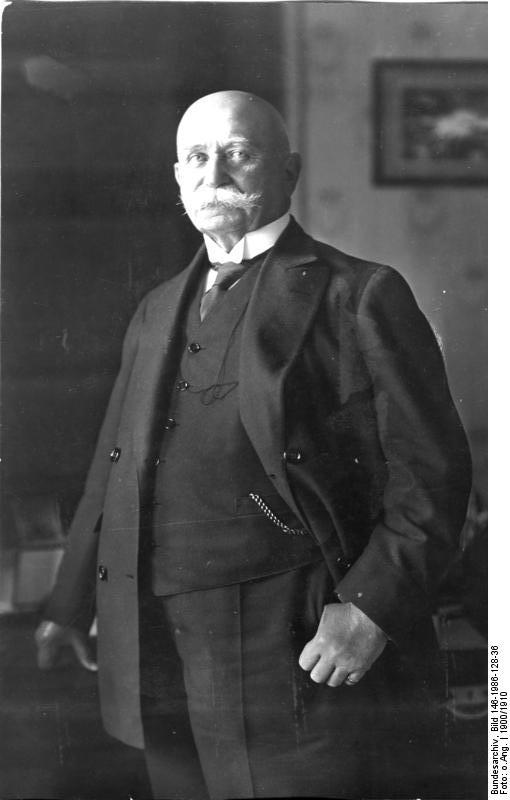
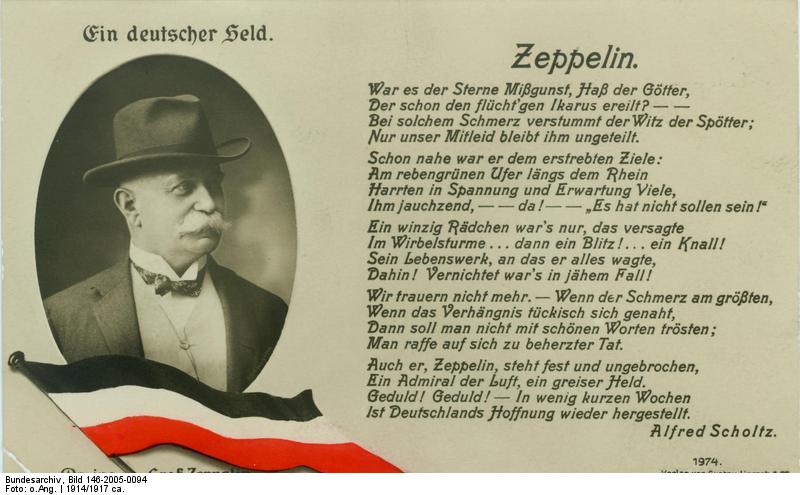
German general and inventor of the rigid airship.

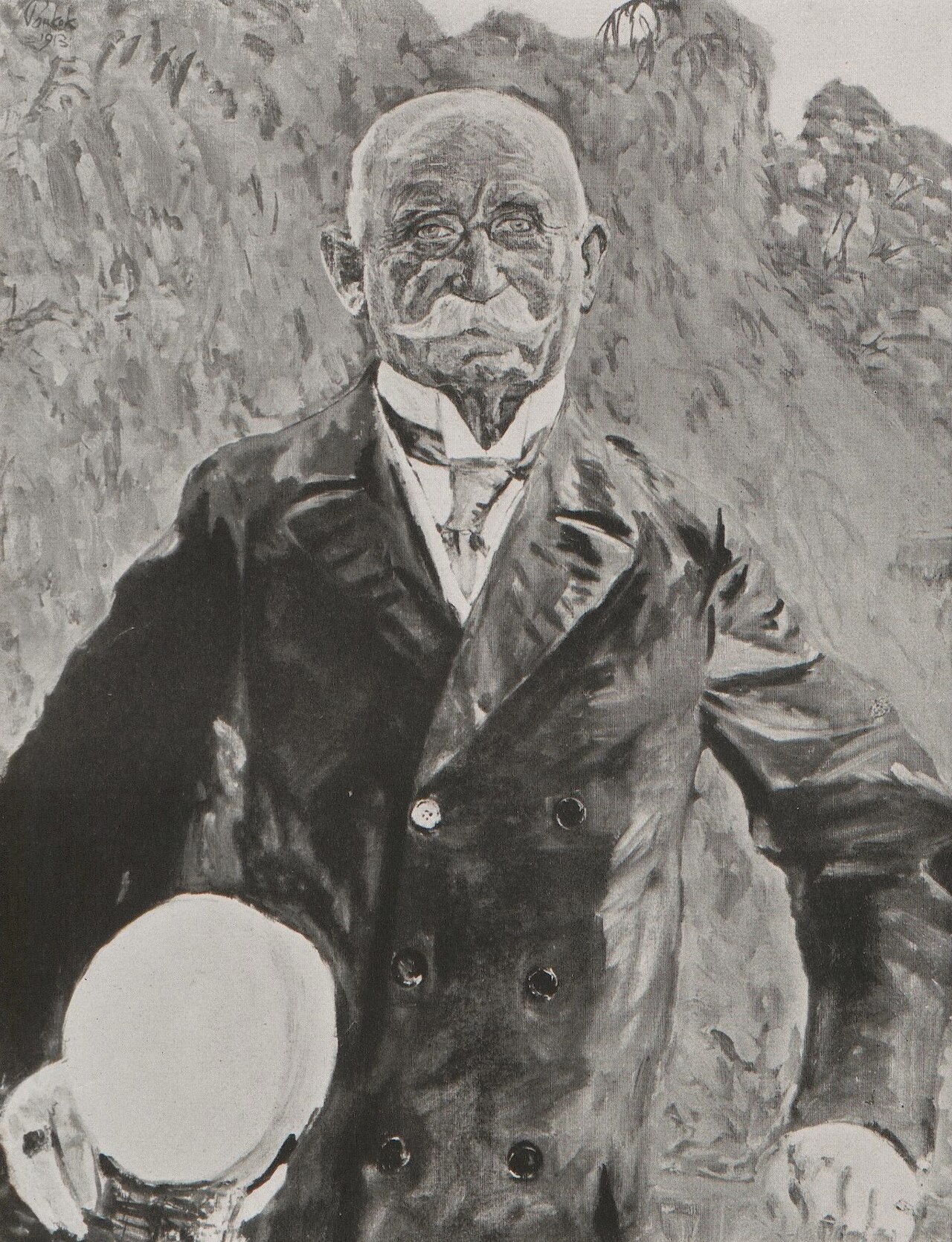
Bernhard Pankok · Public domain
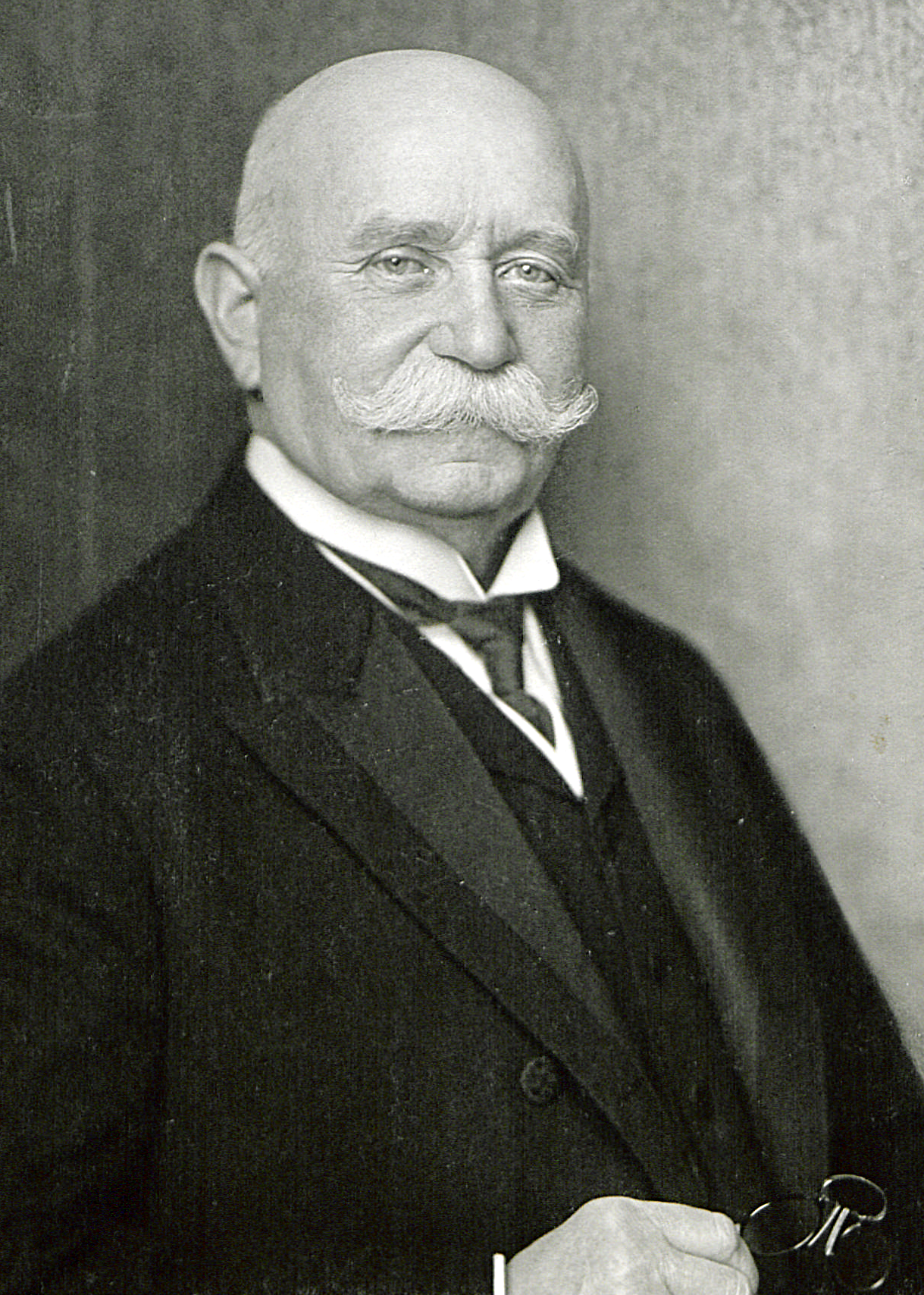
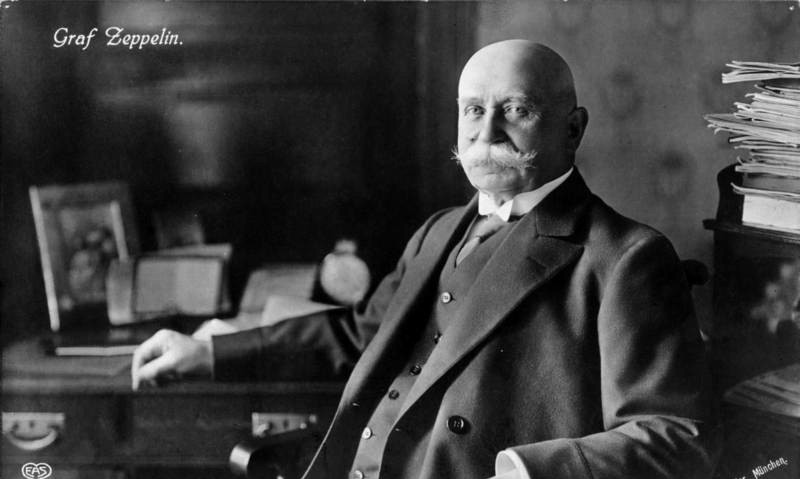
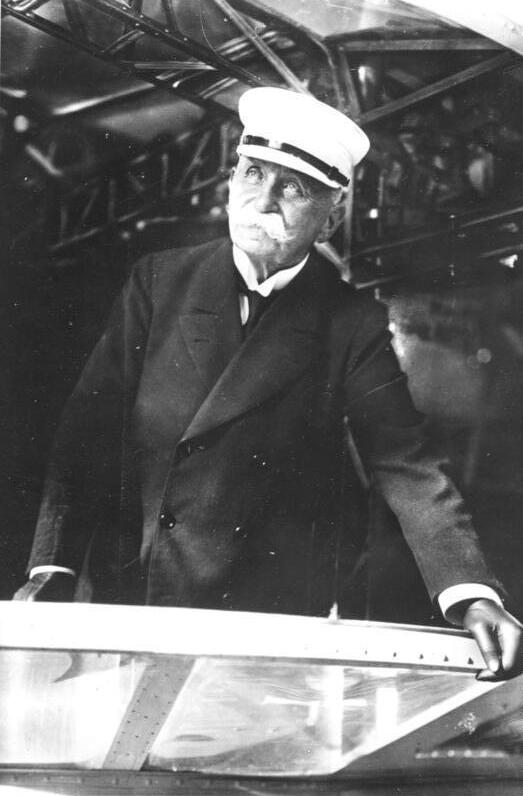
Count Ferdinand von Zeppelin, born in 1838 and died in 1917, was a German general who later invented the rigid airships that bore his name. The term "Zeppelin" became a household word for airships, which dominated long-distance travel until the 1930s. He established the company Luftschiffbau Zeppelin.
Zeppelin came from a noble family. The town of Zepelin, after which his family was named, is a small community near Bützow in Mecklenburg. His father, Friedrich Jerôme Wilhelm Karl Graf von Zeppelin, served as a Württemberg minister and Hofmarschall; his mother was Amélie Françoise Pauline, born Macaire d'Hogguer. Ferdinand grew up with a sister and brother at the family's Girsberg manor near Konstanz, where private tutors educated him. He married Isabella Freiin von Wolff in Berlin; she came from the house of Alt-Schwanenburg, in what is now Gulbene, Latvia. Their daughter, Helene (Hella) von Zeppelin, married Graf Alexander von Brandenstein-Zeppelin in 1909. Zeppelin's relative by marriage, Baron Max von Gemmingen, volunteered at the start of World War I, despite being past military age, and served on the civilian airship LZ 12 Sachsen. Another relative, Count Everhard von Zeppelin, a Second Lieutenant in the German Lancers, married Mary "Mamie" McGarvey in 1895; she was the daughter of Canadian oil magnate William Henry McGarvey. A different Count von Zeppelin married a granddaughter of the 1st Earl of Ranfurly.
Zeppelin's military career began in 1853 when he entered the polytechnic in Stuttgart. Two years later, he became a cadet at the military school in Ludwigsburg and then an officer in the Württemberg army. Promoted to lieutenant in 1858, he received leave to study science, engineering, and chemistry at Tübingen, but Württemberg's mobilization for the Austro-Sardinian War in 1859 interrupted these studies when he was called to the engineering corps in Ulm. In 1863, he took leave to observe for the Union's Army of the Potomac during the American Civil War in Virginia. He later traveled to the Upper Midwest with a party that likely included two Russians; guided by Native Americans (probably Ojibwe), they canoed and portaged from Lake Superior up the St. Louis River to Crow Wing, Minnesota, on the Upper Mississippi. Reaching Saint Paul by stagecoach and hired carriage, he met German-born balloonist John Steiner and made his first balloon as
- born
- 8 July 1838
- died
- 8 March 1917
- field
- Military, Aeronautics
- nationality
- German
- known_for
- Inventing the Zeppelin rigid airship
Lore & Background
Ferdinand von Zeppelin was the scion of a noble family, born to Württemberg Minister Friedrich Jerôme Wilhelm Karl Graf von Zeppelin and his wife Amélie Françoise Pauline. He spent his childhood at Girsberg manor near Konstanz, educated by private tutors. He married Isabella Freiin von Wolff in Berlin, and they had a daughter, Helene von Zeppelin.
Zeppelin began his army career as a cadet at Ludwigsburg in 1855, later studying science and engineering at Tübingen. He served as an observer for the Union Army in the American Civil War, where he made his first aerial ascent with balloonist John Steiner in St. Paul, Minnesota, on 19 August. This experience is said to have inspired his later thinking about dirigible lighter-than-air craft.
After retiring from the army in 1891, Zeppelin devoted full attention to airships. He hired engineers Theodor Gross and later Theodor Kober to refine his design, which featured a rigid aluminium framework, separate internal gas cells, and a modular frame. He received a patent in August 1895 for an 'airship-train' design. With financial backing from Carl Berg and others, he formed the Gesellschaft zur Förderung der Luftschiffahrt and began construction of the first successful rigid airship, the Zeppelin LZ1.
Reader's Guide
Ferdinand von Zeppelin's significance lies in his development of the rigid airship, which dominated long-distance flight until the 1930s. His designs introduced key innovations: a rigid aluminium framework, separate gas cells that expanded and contracted without ballonets, and a modular structure. Despite early setbacks, including rejection by the Prussian Airship Service and the sacking of engineer Theodor Gross, Zeppelin persisted. His company, Luftschiffbau Zeppelin, became synonymous with airships. The Zeppelin name influenced both military and civilian aviation, though the source article does not detail later events. His legacy is tied to the era of airship travel, which ended with the rise of heavier-than-air aircraft.
Did You Know?
- Zeppelin made his first aerial ascent with balloonist John Steiner in St. Paul, Minnesota, on 19 August 1863.
- He was awarded the Knight's Cross of the Military Merit Order of Württemberg for his service in the Austro-Prussian War of 1866.
- His patent for an 'airship-train' described a design with three rigid sections flexibly connected.
- Zeppelin invested 441,000 Marks, over half the total capital, in the company formed to build his first airship.
A Name Among the Transportation Pioneers
Ferdinand von Zeppelin occupies a distinguished position within a constellation of German minds who collectively reshaped how humanity moves through the world. In the broad catalogue of German inventions and discoveries, he is grouped alongside figures such as Otto Lilienthal, Karl Drais, Werner von Siemens, Hans von Ohain, Henrich Focke, Gottlieb Daimler, Rudolf Diesel, Hugo Junkers, and Karl Benz. Together, this remarkable cohort of inventors, engineers, and industrialists is credited with helping to shape transportation technology in its many forms. While Drais is recognized for the bicycle and Benz for the first practical automobile, and Lilienthal is hailed as the father of aviation, Zeppelin stands among them as a fellow pillar of this transformative era. His inclusion in this specific grouping underscores that his contributions were not isolated but part of a sweeping, interconnected movement that redefined the very possibilities of human mobility. In the landscape of German engineering achievement, his name carries the weight of a tradition that produced not just one breakthrough but an entire generation of world-altering advances in how people and goods traverse the world.
The German Innovation Ecosystem
Ferdinand von Zeppelin did not emerge from a vacuum. He was a product of a national tradition in which Germany has long served as a home for some of the most consequential inventors, discoverers, and engineers in history. The same soil that gave the world the Geiger counter, the modern refrigerator, the first fully automatic digital computer, and the first space rocket also nurtured Zeppelin's work in transportation. This was not a single flash of genius but a sustained, multi-generational commitment to pushing the boundaries of what is technically possible. From Paul Nipkow's disk to Karl Ferdinand Braun's cathode ray tube, from Konrad Zuse's pioneering computers to Wernher von Braun's space rockets, the German innovation ecosystem produced breakthroughs across every conceivable domain. Zeppelin's place within this ecosystem is significant precisely because it reflects a culture that valued practical ingenuity, rigorous engineering, and the translation of abstract ideas into tangible, world-changing objects and processes. His work in transportation technology was one thread in a vast tapestry of German achievement that spanned centuries and disciplines.
Invention, Discovery, and the Blurred Boundary
The question of what constitutes an invention versus a discovery is one that the broader context of German innovation raises in a way that illuminates Zeppelin's own contributions. In the German tradition of cataloguing inventions and discoveries, the line between the two is often acknowledged as unclear. Ideas, objects, processes, and techniques that are invented, innovated, or discovered by Germans are all grouped together, and things found for the first time are frequently called inventions. This philosophical ambiguity is not a weakness but a reflection of the creative process itself. For Zeppelin, whose work helped shape transportation technology alongside peers like Drais, Benz, and Lilienthal, the distinction between conceiving a new mode of movement and discovering a previously unknown principle of physics or engineering may have been less important than the practical outcome: a new way for humanity to move through space. The German innovation tradition, in which Zeppelin is firmly embedded, treats the act of bringing something new into the world—whether through pure invention or through discovery—as equally worthy of recognition and celebration.
A Legacy Woven Into a Broader Tapestry
Ferdinand von Zeppelin's name appears in the broader narrative of German contributions to human progress not as a solitary figure but as one node in an extraordinarily dense network of achievement. The same tradition that produced Johannes Gutenberg's movable-type printing press—ranked by Time Life magazine as the most important invention of the second millennium and by the A&E Network as the most influential person of that era—also gave the world Zeppelin's contributions to transportation. Germany's record of scientific and technical excellence is staggering: from the discovery of X-rays by Wilhelm Röntgen to the quantum mechanics of Einstein, Planck, Heisenberg, and Born, from the founding of modern medicine by figures like Robert Koch and Emil Behring to the nuclear fission discovered by Otto Hahn. In this vast catalogue, Zeppelin's work in transportation technology holds its own, standing alongside the bicycle, the automobile, and the space rocket as part of a collective effort to reshape the physical world. His legacy is inseparable from the broader story of what German ingenuity has meant to the trajectory of human civilization.
Gallery
Frequently Asked Questions
Who is Ferdinand von Zeppelin?
Ferdinand von Zeppelin was a German military officer and aristocrat who went on to pioneer the design of rigid airships. He is best remembered as the man whose surname became synonymous with these early flying vessels.
What did Ferdinand von Zeppelin invent?
He developed the rigid airship, a large structurally reinforced flying machine capable of carrying passengers and cargo over long distances. These craft became so closely tied to his name that 'Zeppelin' entered everyday language as a generic term for airships.
When was Ferdinand von Zeppelin born and when did he die?
He was born on 8 July 1838 and passed away on 8 March 1917, living through a period of rapid technological change in Germany. His career spanned both military service and the early era of aviation.
What company did Ferdinand von Zeppelin found?
He established Luftschiffbau Zeppelin, the manufacturing firm responsible for building and developing his rigid airships. The company became the primary producer of these vessels for decades.
Why is Ferdinand von Zeppelin considered important?
His airships dominated long-distance commercial and military travel well into the 1930s, making him a key figure in early aviation history. The very word 'Zeppelin' became a household term, cementing his legacy far beyond the engineering world.
More in Inventors Of Everyday Objects 1-24
Spotted an error? Know more?
This is a living reference — every entry is fact-audited, and reader corrections feed straight into our audit queue. Suggest an edit · See this site's audit record